Founder Spotlight on Hoxton Ventures
From Google DeepMind to Finster: Building AI That Works for Finance
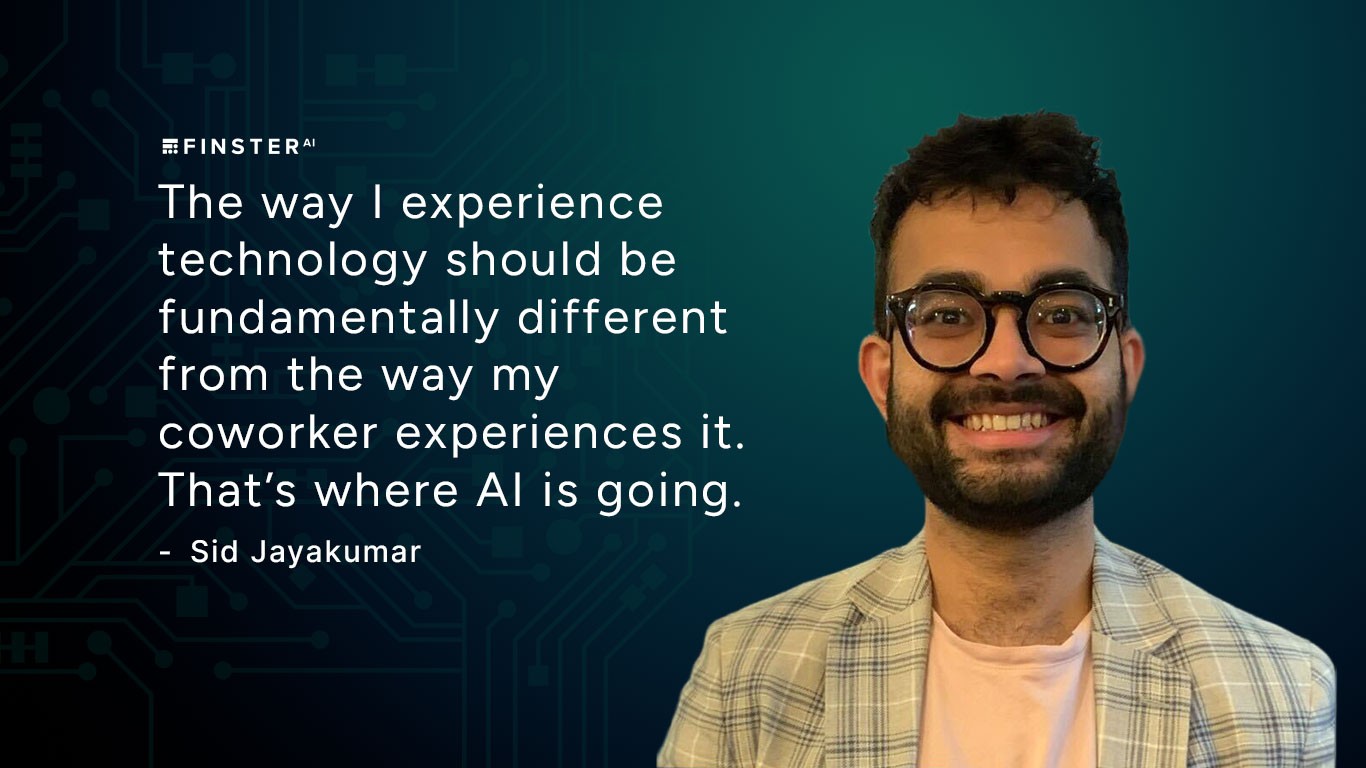
Recently, Hoxton Ventures sat down with Finster AI founder Sid Jayakumar as part of their Founder Spotlight series. The conversation spans Sid’s journey from early work at DeepMind to building an AI-native platform purpose-built for finance, and dives into how personalization, trust, and workflow design will define the next era of AI in banking and asset management.
Read the interview transcript here.
Below are a few of the topics covered and brief summary for each:
Sid’s background
Coming from years of foundational AI research at Google DeepMind, founder Sid Jayakumar saw that finance sits in the category of industries where the hardest problems are still unsolved: hallucination-free reasoning, auditable answers, and the fusion of structured data with language models. This gap was keeping finance professionals from realizing the full value of AI.
Why generic AI falls short in finance
Large language models are impressive reasoning engines, but finance is not a generic reasoning problem. The work depends on provenance, recency, internal context, and accountability. Analysts are not asking trivia questions. They are testing assumptions, reconciling conflicting sources, and preparing outputs that must withstand scrutiny from clients, regulators, and investment committees.
Generic chatbots struggle here. They can summarize, but they cannot reliably explain where a number came from, why it matters, or how it fits into a specific firm’s way of working. That gap is not cosmetic. It is existential in regulated environments.
This is why many early AI deployments in banks stalled. They optimized for novelty rather than workflow. They delivered speed without trust.
Personalization is the real breakthrough in the context of finance workflows
The meaningful shift now underway is toward AI that learns how you work. Not through better prompt engineering, but through usage, feedback, and models having the right context.
At an individual level, this means two analysts can ask the same question and receive different answers because they need different things, and the model knows it. One may want exhaustive sourcing and downside scenarios. Another may want a tight client-ready narrative. Over time, the system learns these preferences and remembers them.
At a firm level, personalization compounds. Internal documents, historical analyses, prior deal logic, and house views become a durable moat. When structured correctly, internal data does not just sit behind a firewall. It actively improves reasoning, consistency, and institutional memory.
This is where AI becomes a culture amplifier rather than a threat.
AI as a collaborator rather than an isolated tool
One common concern is that removing “grunt work” removes discipline. In reality, repetition does not equal learning. Feedback does.
AI allows senior professionals to see how a junior arrived at an answer, not just the final output. That changes coaching entirely. Instead of correcting results after the fact, teams can interrogate logic in real time. Why did you pull that source? Why did you weight that assumption more heavily? Those conversations build better analysts faster.
Iteration speed also changes behavior. When answers arrive quickly, teams test more hypotheses. Bad ideas are killed earlier. Good ideas are sharpened. The floor becomes more interactive, not quieter.
In that sense, AI restores something finance lost to scale: time to think.
Who benefits most from this shift
Contrary to popular belief, this transformation favors ambition. Analysts with curiosity and judgment become more valuable sooner. Senior bankers spend less time delegating mechanical tasks and more time advising clients. Boutique firms gain leverage they never had before. Large institutions surface internal insight that was previously trapped in silos.
Roles that depend on relationship-building and decision-making remain protected. AI does not replace them. It clears the noise around them.
Why AI-native platforms matter
Many vendors claim to be AI-native. Most are not. Wrapping a chatbot around legacy systems does not change how work gets done. True AI-native systems start from the premise that reasoning, retrieval, and verification are core functions, not add-ons.
This distinction explains why vertical platforms continue to outperform horizontal tools in finance. Domain-specific data, granular citations, permissioning, and workflow awareness are not features you bolt on later. They are architectural choices.
The direction of travel
AI in finance will not look like a single omniscient chatbot. It will look like a network of specialized agents embedded in daily workflows, proactively surfacing insight before it is requested.
The firms that win will not be the ones that automate the most tasks. They will be the ones that personalize intelligence the best.
That is not a future where finance becomes less human. It is one where human judgment finally gets the tools it deserves.
This philosophy is central to how Finster AI was built.